






Blog

Why 60% of Transformations Fail – and How to Beat the Odds

Kevin Husell

Kevin Husell / Leadership Coach / 18 Dec 2025

Change is inevitable. Growth is optional. What’s your move?

Change is inevitable – growth is a choice. Even if we did nothing, organisations change over time. Markets shift, technology evolves, and organisations face constant pressure to adapt. Meanwhile, people age, learn, and transform by nature. So, the question isn’t whether change will happen, but whether we invest in it to grow. And growth? That’s never easy.

workshop

Transforming yourself is tough. Transforming others is tougher. But shifting an entire organisation – with its people, systems, and culture? That feels near impossible. The challenge is significant – roughly 60% of transformations fail.

Leaders often miscalculate the effort needed, overestimate their organisation’s readiness, and misunderstand how people truly connect to change.

Yet, with the right investment in the transformation journey, success is within reach. This is where Organisational Development comes in – a deliberate effort to steer the organisation toward meaningful, intentional improvement.

In this article, I’ll break down the essentials:

  • Why organisational assessments matter
  • How to create the right climate for change
  • The role of leadership, direction and organisational structure
  • How change management models bring it all together

Let’s explore how they unlock transformation success.

tree

Organisational Assessments:
The First Step in Your
Transformational Journey

Before navigating change, you need to know where you stand. Think of it like plotting a course – you can’t map the path without a starting point. An organisational assessment provides that clarity.

By evaluating your current state, you establish a baseline, uncover challenges, and identify strengths and weaknesses. It’s an objective lens – free from internal biases – that reveals what’s really happening. While self-assessments are possible, they’re tricky; seeing oneself clearly is hard. This is where external expertise brings sharper insight.

The process includes scoping the evaluation, interviewing stakeholders, and analysing various key factors – such as financials, employee surveys, organisational charts, system architecture, task management tools, and process maps – among other critical elements. Subject matter experts add depth, ensuring the findings steer you toward a bold, valuable future. Many firms offer tailored frameworks to fit organisational needs.

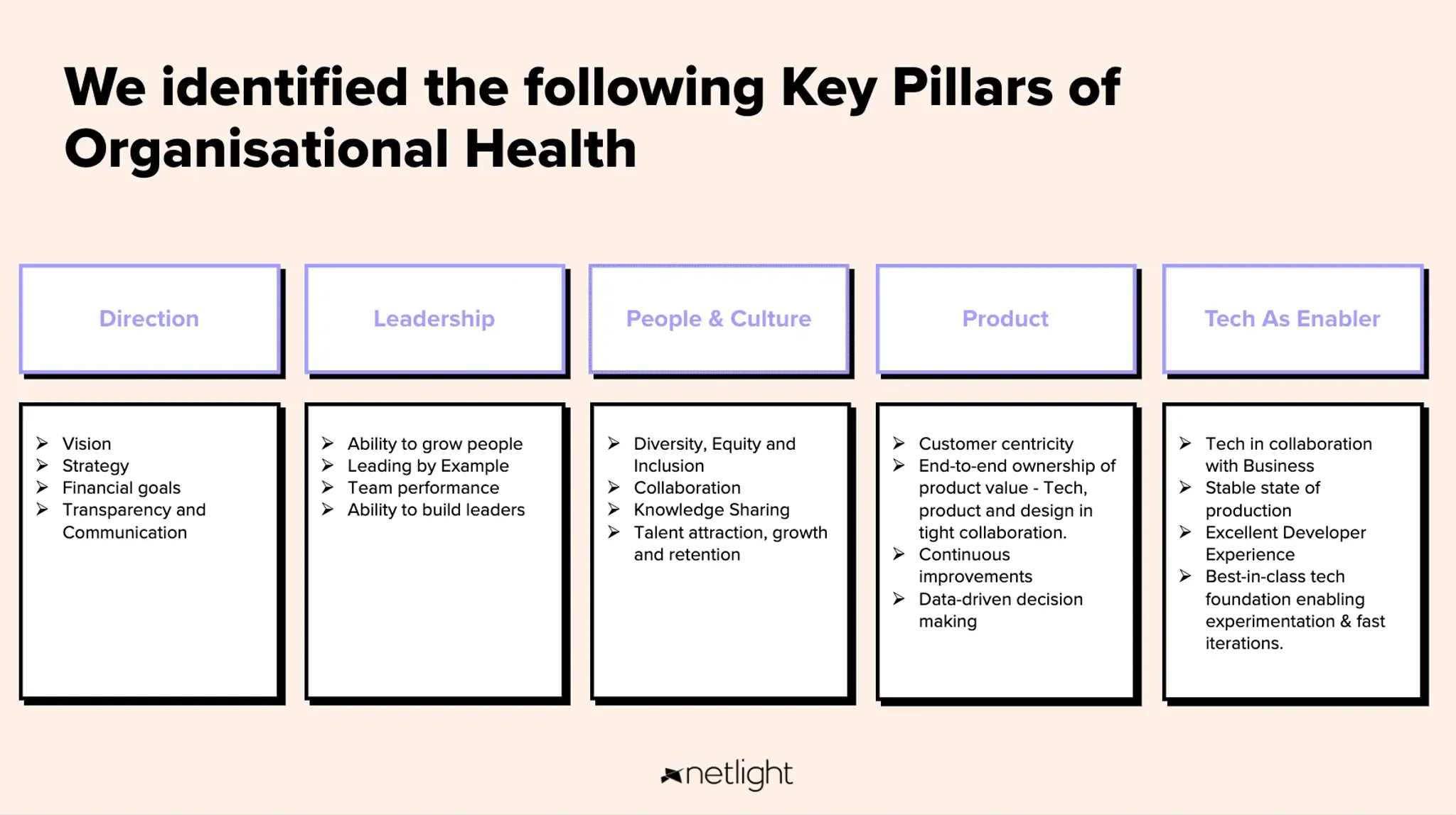
For example, at Netlight, we assess key areas such as Direction, Leadership, People & Culture, Product, and Tech to help organisations gauge their maturity and shape a clear vision for organisational transformation.

To take a real-life example, Microsoft’s transformation under Satya Nadella in 2014 highlights the stakes. Taking over a siloed, stagnant giant, Nadella identified a “know-it-all” culture stifling innovation. By shifting to a “learn-it-all” mindset and betting on cloud growth, he turned Microsoft into a trillion-dollar leader. Whether through formal assessments or deep introspection, understanding your starting point reveals challenges and opportunities, laying the foundation for a bold vision ahead.

key pillars of organisational health

Understanding organisational maturity is key. Different frameworks help in giving a clear view of where you stand and what to focus on.

How to Create a Climate
for Successful Change

Any transformation will face resistance – employees clinging to old workflows or leaders doubting the need. Kotter says 75%+ management support is crucial to driving transformation. So, the assessment helps create urgency, letting you craft a compelling “why” that secures the buy-in needed for change. You can tackle doubts head-on by showing the cost of inaction – the “cost of remaining the same” – and rallying a coalition to embark on a transformation journey.

Once you’ve created that sense of urgency, the next step is a clear vision. A strong vision gives everyone purpose and direction, aligning the team to move forward together. Without it, progress can stall due to misalignment and divergent priorities. For instance, Microsoft’s transformation under Satya Nadella succeeded because he created a unified vision for cloud and collaboration, which shifted the company from stagnation to dominance.

Without a clear, well-communicated, and well-understood vision, your organisation is just running on a treadmill – busy but stuck.

This is where the importance of leadership comes in. Kotter stresses the need for a guiding coalition – committed leaders who drive the vision forward. Research backs this up: transformations are 2.6 times more likely to succeed with strong leadership, though failure rates hover around 60% when buy-in falters. In 2021, only 35% of global companies met their digital transformation targets, slightly up from 30% in 2020, according to BCG (2021).

If leaders don’t support the vision and strategy, the effort will fail. Leadership coaching can improve employee retention, align goals, and foster long-term change. Without it, blind spots – such as resistance or misalignment – will fester.

train

Balancing Leadership, Structure, and Vision for Successful Transformation

A clear vision and strong leaders require a solid backbone: your organisational structure. Assess communication flows, decision-making processes, team setups, and dependencies – do your teams have defined roles, the right skills, and the resources to deliver?

Smooth workflows are non-negotiable. Ensure capabilities align with the vision, syncing strategy, structure, and systems. Flow engineering methods like Value Stream Mapping and Team Topologies can pinpoint bottlenecks, inefficiencies, and roadblocks, optimising processes efficiently.

Transformation isn’t just about direction, leadership, or organisational structure – it’s the interplay of these three critical elements. Think of them as a triangle, with each side supporting the others. Microsoft balanced all three to launch its cloud era, while Nokia’s rigid structure caused its downfall.

As a Finn, I can’t help but reflect on Nokia’s failure – a powerful reminder of how a siloed structure can derail even a giant. Its inability to pivot to smartphones by 2013 cost it its mobile lead. Microsoft’s acquisition of Nokia’s phone business in 2014 also faltered due to poor integration and a misread market, leading to a costly write-off.

In contrast, under Nadella, Microsoft’s agile structure pivoted to cloud success. This shows why transformation needs owners – managers or coaches – to balance the triangle: strong leadership fuels vision, clear direction steers efforts, and solid structure powers execution. If any falters – wobbly leaders, vague goals, or under-resourced teams – the whole thing crashes, risking company and change alike.

Team Topologies exercise

Team Topologies offers a strategic approach to shaping and optimising your organisational structure. The picture is from a hands-on Team Topologies workshop organised at Netlight’s EDGExcellence event.

Driving Transformation:
The Power of
Change Management
Models and Support

Successful transformation relies on both structure and human buy-in, and organisational assessments ensure they align. These assessments identify where processes, structures, and people are in sync or out of step, providing leaders with the insights needed to guide change.

Change management models, whether process- or people-focused, offer frameworks to execute transformation. Models like Kotter’s Eight-Step and ADKAR provide valuable approaches, but the key is integrating both to address the practical and emotional aspects of change.

Process-focused models, like Kotter’s, offer structured roadmaps, from creating urgency to embedding new behaviours. People-focused models, like ADKAR, ensure employees are engaged, building awareness, desire, and reinforcement to sustain change.

Even with these models, transformation demands ongoing support. Training, coaching, and a dedicated transformation team are vital to maintaining momentum. Without them, organisations risk “organisational debt” – turnover, burnout, and lost customers – that undermines long-term success.

Neglect transformation, and it’s like riding a rusty bike: you might reach your goal, but it’s slow and painful. Support and reinforcement keep the wheels turning smoothly, driving efficient and effective transformation.

broken bycycle

Conclusion:
Transformation is a Journey,
Not a Destination

Transformation isn’t a one-off event – it’s an ongoing journey that involves continuous organisational development. Organisational assessments map the starting line, a clear vision sets the course, and robust leadership and change management steer the way, and it all needs a working org structure.

It requires hard work, persistence, and the awareness of everything it takes to transform. By investing in that change, you choose to grow. Will you be a Microsoft, thriving through vision and agility, or a Nokia, buried by missed signals?

As change is inevitable and growth is optional, what’s your move? The time to start is now – let’s shape the future together and turn your transformation vision into reality.


About the Author

Kevin specialises in digital transformation, agile methodologies, and organisational development, with experience in Finnish pension insurance, quantum computing, and Germany’s e-charging and aviation sectors. Skilled in leading multicultural teams across Europe and India, he drives innovation and operational excellence. As a Team Topologies advocate, Kevin helps build high-performing teams and supports impactful change.

Kevin Husell

Kevin Husell / Leadership Coach

Blog
  • Governance
  • Data Strategy
Netlight Consulting

Blog

The 5 Pillars of a Successful Data Strategy

  • Governance
  • Data Strategy

In an era where almost every organisation aims to be data-driven, the path to a successful data strategy isn’t always clear-cut. True success hinges not only on implementing the right systems but also on fostering the right organisational mindset and structures. Aulona Shabani, one of our experts in data transformation, shares the secrets to a successful journey to data maturity based on her hands-on experience.

Blog
  • Ownership
  • Platform
  • Governance
  • Infrastructure
  • Data
Flow

Blog

The Flow State: Omar Moussa on Data Platforms, Ownership, and Keeping the Lights On

  • Ownership
  • Platform
  • Governance
  • Infrastructure
  • Data

In the energy industry, flow is everything. Power runs through grids, turbine blades slice the air, and endless reams of sensor data stream back to servers. For Omar Moussa, it’s not enough that the power flows uninterrupted; the data has to follow. And for that to happen, the chaos needs to be tamed. In the energy industry, flow is everything. Power runs through grids, turbine blades slice the air, and endless reams of sensor data stream back to servers. For Omar Moussa, it’s not enough that the power flows uninterrupted; the data has to follow. And for that to happen, the chaos needs to be tamed.


Blog
  • Change Management
  • Leadership
  • Strategy
Netlight Consulting | Street-smart Change management

Blog

Turning Doubters to Believers — Street-smart Change management

  • Change Management
  • Leadership
  • Strategy

The “streets of change” are messy, unpredictable, and full of moments you can’t script. A plan by itself can’t account for what truly matters — the emotional journey. The real work isn’t just executing a plan; it’s turning doubters into believers