Press Release
Netlight as knowledge partner to Unlocked: a new forum for the most important questions facing business leaders
Press Release
AI is taking over tasks traditionally performed by junior employees. For many companies, the conclusion seems obvious: If technology can do the work, why hire as many young people?
But that reasoning overlooks what junior employees actually contribute. Their value goes far beyond the tasks they perform. They bring fresh perspectives, challenge established thinking and help others grow. And over time, they become the experienced professionals and leaders every organisation depends on.
A report from Uppsala University and the Swedish Agency for Growth Policy Analysis shows that the share of recent graduates working at companies most exposed to AI has fallen by roughly eight percentage points since 2023. In the United States, research from Stanford University suggests that employment among 22- to 25-year-olds in AI-exposed occupations is 19 percent below where it would have been had it followed the trend in less-exposed fields.
We cannot yet say precisely how much of this shift is driven by AI. But it raises an important question: Are we underestimating the value of young talent? One argument I hear repeatedly is this: Why invest in young people when they’ll probably leave after a few years anyway? But what does that say about us as employers? Have we given up on building workplaces where the best people want to stay?
If our response to losing talent is to stop investing in it, we risk making the problem worse. Perhaps the real issue lies in our culture, leadership or the opportunities we offer. Besides, young people don’t have to stay for a decade to make a meaningful contribution.
Consider Anna, who graduated a year ago. A new colleague joins her team, and suddenly she’s the one being asked for advice. As she shares what she’s learned, she grows more confident and takes on greater responsibility.
But something else happens, too. Knowledge spreads, relationships develop and the organisation grows stronger. This is how a culture of learning takes shape, with people constantly helping one another improve.
Yet we still tend to see junior employees as people who must first learn, gain experience and only then begin to contribute. We design trainee programmes, sometimes with limited expectations from the outset, rather than focusing on what they can bring to the table from day one. We need to stop seeing junior talent merely as an investment in the future and start recognising the value it creates today.
A 25-year-old may bring ideas a 45-year-old would never have considered. Sometimes the person who knows the least asks the question that changes everything, precisely because they aren’t constrained by how things have always been done.
Experience matters enormously, but so does the absence of it. With AI, we have an opportunity to unlock that potential faster than ever. Rather than replacing young talent, why not use technology to help them contribute more, earlier?
But that requires us to rethink how we lead. We are often too cautious with junior colleagues. When delegating, we explain how something should be done, but rarely why it matters. We should do the opposite.
Someone who doesn’t know the established approach may discover a better one, provided they understand the purpose and the problem we’re trying to solve. Instead of handing over a checklist, give people context, ownership and room to surprise you.
Give responsibility early, set high expectations and provide the support needed to succeed. Start with a clearly defined, manageable scope of responsibility and expand it over time. And don’t mistake lowering expectations for kindness. High expectations is an expression of trust. The confidence gained from overcoming a difficult challenge, knowing someone believes in you, is hard to replace.
Of course, this doesn’t mean throwing inexperienced employees into complex situations and hoping for the best. Responsibility must come with strong leadership, support and psychological safety, including room to make mistakes.
If nobody gradually takes over parts of our work, neither they nor we have room to grow. Instead, responsibilities accumulate while the next generation waits for its turn. Perhaps it’s no coincidence that many step into leadership roles in their thirties or forties, and fail to delegate parts of their work, just as family responsibilities and other pressures increase.
Why not start preparing them much earlier? Onboarding isn’t a two-week process. Development needs to become part of the culture.
At Netlight, our working model is designed to help people take on challenges they haven’t faced before, without facing them alone. Every consultant has a senior colleague who acts as a sounding board and helps ensure quality for the client, a mentor who supports personal development, and a sales manager who helps match them with the right assignments.
They also have access to more than 2,000 colleagues and a culture that encourages people to ask questions, contribute and learn from one another. This allows junior colleagues to take on meaningful responsibilities early, backed by experience and expertise. We develop people while delivering value, rather than treating the two as separate objectives.
Every company has different circumstances. But the ability to recognise potential, unlock it early and build workplaces where new generations want to join and stay will only become more important. Ultimately, this is about more than the future of individual companies. It’s about the kind of society we want to build.
The early years of a career shape how people develop, take responsibility and find their place in working life. If we eliminate those opportunities because the immediate return appears too small, the consequences will reach far beyond our next quarterly results. We risk leaving a generation with fewer opportunities to develop, and organisations with too few people ready to lead.
AI gives us extraordinary opportunities to rethink how work gets done. But perhaps the greater opportunity is to rethink what people are capable of. Instead of asking how much junior work AI can eliminate, we should ask how much more the next generation could achieve with it.
After all, shouldn’t our ambition be to help the next generation surpass us? We have the tools. What we need now is the will.
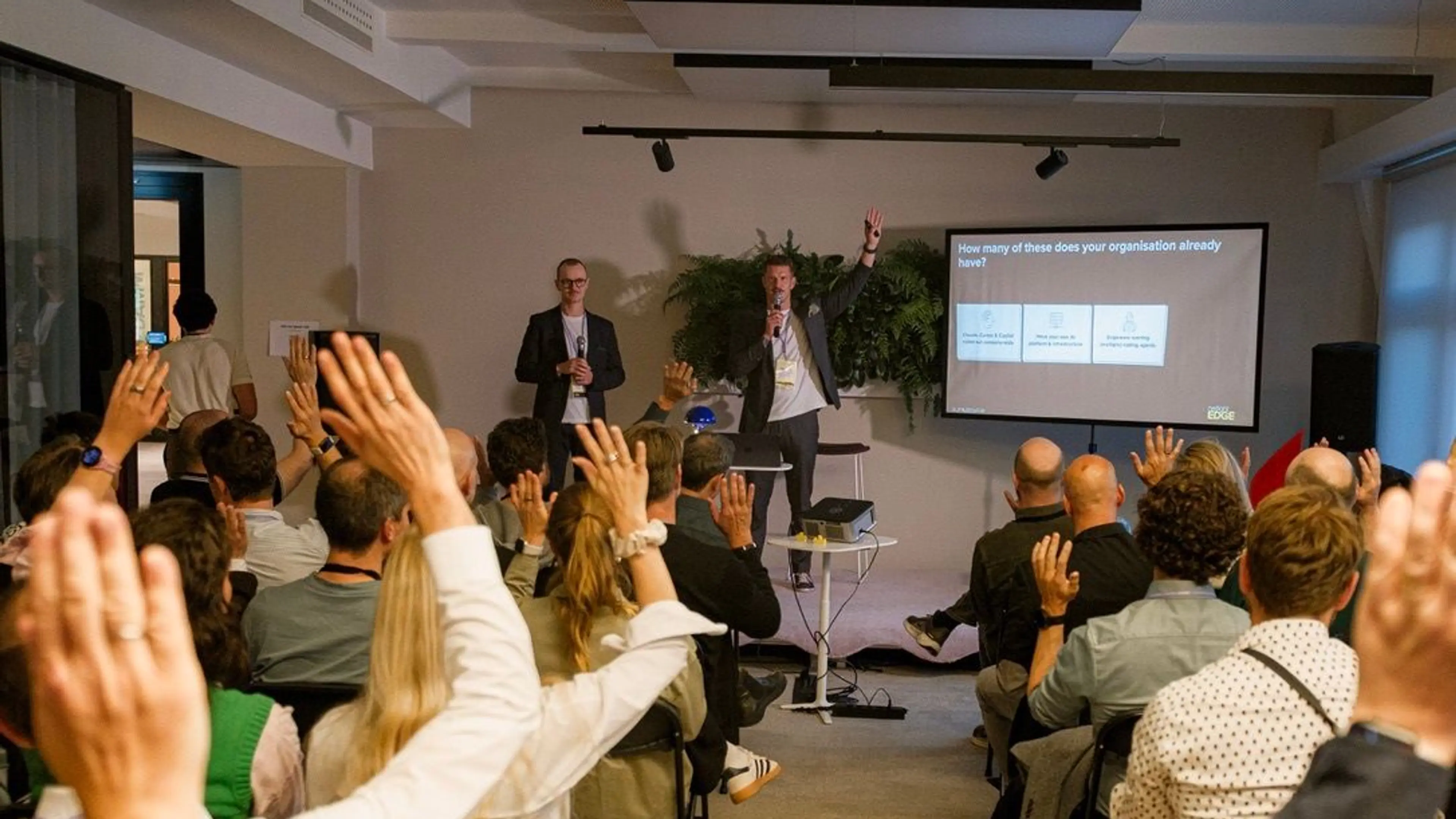
This article was originally published on the Swedish business news sites Dagens PS and Realtid as part of our collaboration with the newstech company RLVNC. Together, we have launched Unlocked, a new knowledge platform in Sweden featuring a podcast, articles, newsletters, and a live event. Our upcoming event, Unlocked Live, is a special edition of our Edge event for business leaders and decision makers, taking place on 14 January in Stockholm. It will bring together experts from research, business, politics, and culture to discuss the future of AI and business, creating space for new insights and perspectives. Learn more and join the conversation at realtid.se/unlocked.
Next up
Haval has always been intrigued by deep human and organisational questions. As a Senior Talent Manager at Netlight, he holds ultimate responsibility for Netlight’s international growth and organisational development.
Haval Khosro
Press Release

Article
AI is increasing both capacity and speed across organisations. But real business value is not created through more tools and faster decisions alone. It comes from direction, human judgement, and the ability to connect technology, business, and people.
Blog
97% of companies have deployed AI agents. Only 29% report real organisational return. That is not a technology problem.